

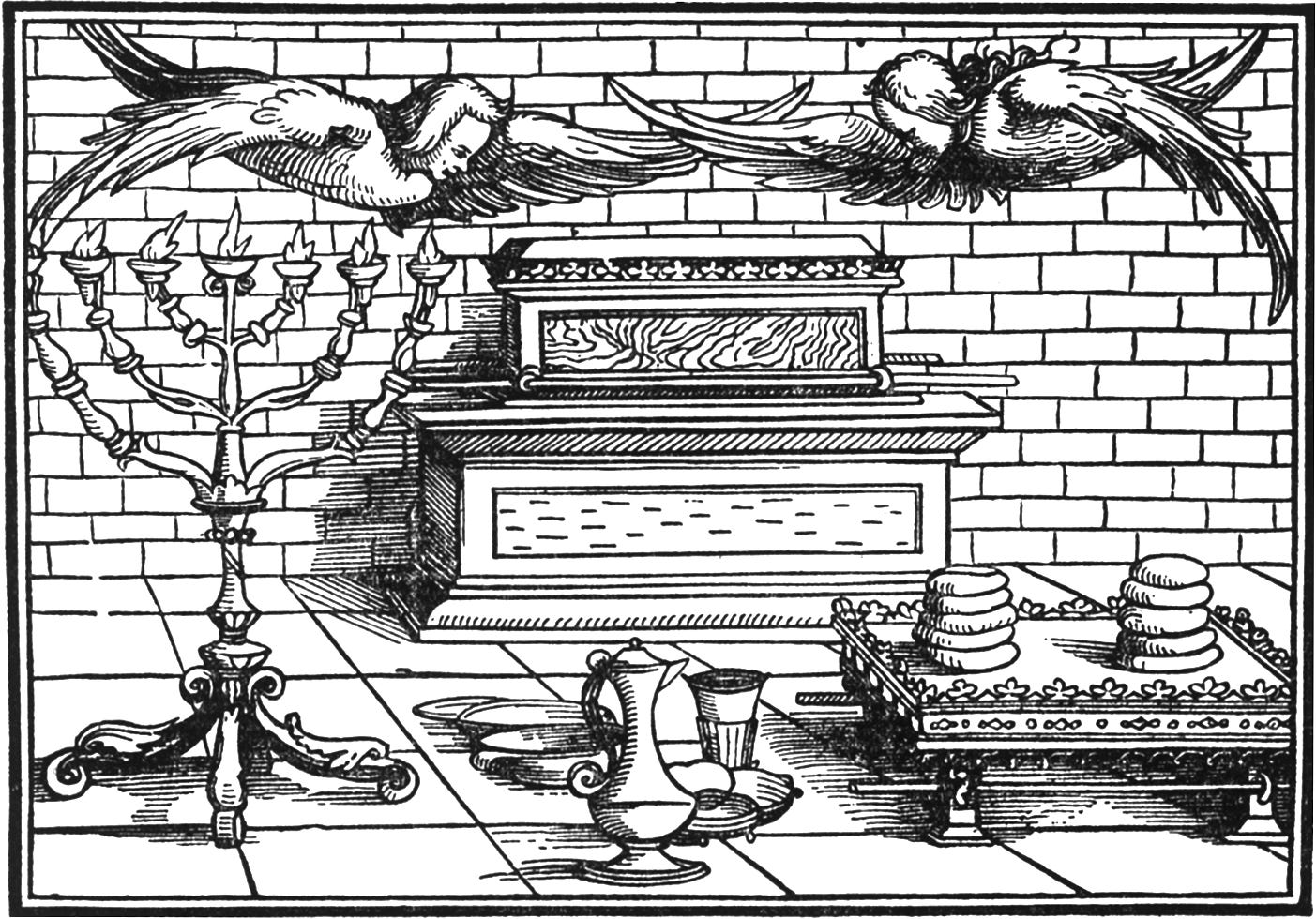
From Holbein’s Bible Woodcuts, Exodus 25:21-22
One of the fundamental articles of faith that Christians from the very beginning have held to is that Jesus Christ provides the forgiveness of sins. One of the tenets of the Apostle’s Creed is the statement, “I believe… in the forgiveness of sins”. The Apostles connected the forgiveness of sins to the death and resurrection of Christ. “In him we have redemption through his blood, the forgiveness of our trespasses, according to the riches of his grace” (Ephesians 1:7 (ESV)), “For I delivered to you as of first importance what I also received: that Christ died for our sins in accordance with the Scriptures, that he was buried, that he was raised on the third day in accordance with the Scriptures” (1 Corinthians 15:3–4 (ESV)).
Every single Christian believer, from the first disciples down through the past 2,000 years of Christ’s church has understood that Jesus died, He rose from the grave, and this is how we are reconciled to God.
Now, this last statement is something that I believe could be affirmed by the three major branches of Christendom1, Protestants, Roman Catholics, and Eastern Orthodox alike. Now in our day of ecumenism, which sadly comes from pressures both on the liberal and conservative sides of religion (for very different reasons2) the temptation might be to simply be satisfied with this statement, and move along. Let’s all join hands and form a ring. However, any kind of unity that appears here is quickly shot down as soon as people start asking the how question. How exactly does Jesus’ death on the cross mean my sins can be forgiven? The fact of the matter is that the three groups mentioned above all have different answers to the question. As a matter of fact, the Eastern Orthodox complain that westerners focus too much upon Christ’s death and not enough on His life and resurrection.
This gets us into discussions about the nature of the Atonement. Atonement being a word that basically refers to the forgiveness of sins in general, although is sometimes applied particularly to Christ’s death. The standard Protestant understanding, or “theory”3 of Atonement is called penal substitutionary atonement (referred to henceforth as simply PSA)4. If we break down the parts of PSA, it is “penal” because it has respect to God’s legal justice, specifically the penalty for sin. It is substitutionary because Christ goes in our stead. Sometimes the similar term “vicarious” is used, although we should mention that while Christ certainly does act on our behalf, as in He is doing something for us; when we talk about substitution we are saying that He acted on our behalf by taking our place for us. And so, when we put it all together, PSA is the statement that our sins are forgiven because Jesus Christ, the incarnate Son of God, went in our place, taking the divine penalty for sin upon Himself.
A full treatise in defense of PSA would involve an understanding of various aspects of the Bible and theology: the nature of God, God’s Law, anthropology, sin, etc. The purpose of this article will be limited specifically to understanding PSA through the Bible’s own presentation of Christ’s death on the cross as a propitiation.
Propitiation
Propitiation is one of the key terms in evangelical Protestant theology. The most basic understanding of the term is “expiation”, or “appeasement”; that wrath is turned away. The term can be used with respect to earthly matters as well as divine and spiritual matters. The essence is simply that one party is angry with another, and a propitiation, or to propitiate, is turning that anger away. The Hebrew background also carries this idea of “covering”, so that a wrongdoing is covered, or made like it isn’t so. Perhaps the reason why the term has been controversial is because of its presupposition of divine wrath against sin, and the idea that God the Father poured out His wrath upon God the Son. However, we will see that the term (and its usage in this way) is entirely Biblical.
At this point we should note that many critics of PSA, especially Eastern Orthodox apologists, will accuse Reformed Protestants of importing Greek pagan ideas of propitiation onto the text of the New Testament. In response to this, I want to say that since the NT is written in Greek, it is obviously using Greek vocabulary. Now are the Greek terms being used going to have an already established understanding to Greek readers? Of course. And if Paul (or any other NT writer) is trying to make things intelligible to his audience, he is going to use words that would effectively communicate his ideas to his audience. This means that it is entirely appropriate to look at how the term is used in Graeco-Roman literature to shed light on how the NT is using the term. But we must keep in mind that while the NT is written to a Greek audience, it is written from a Hebrew (or Old Testament) worldview. And so as a basic principle of New Testament interpretation, which we do not abandon here, the primary meaning of the term as it is being used by the Apostles will come from the way the term (and concept) was understood in the Old Testament. From this point of view, the Protestant wants to make the case that our understanding of propitiation is not pagan, but is rooted in the Hebrew Scriptures themselves.
You have (hopefully) heard the term used many times in sermons and Sunday school lessons in church, and other avenues of theological learning. And so you may be surprised to learn that the term is only used 4 times in the New Testament. Those 4 places are Romans 3:25, Hebrews 2:17, 1 John 2:2, and 1 John 4:10. We will cover them in that order, but first it should be noted that in all 4 places, the context of the passage is Jesus’ work in the forgiveness of our sins, with Rom. 3:25 referring to His “blood”, and Heb. 2:17 discussing Christ’s priestly office. It becomes clear that the death of Jesus Christ is viewed as the propitiation.
Romans 3:25
“whom God put forward as a propitiation by his blood, to be received by faith. This was to show God’s righteousness, because in his divine forbearance he had passed over former sins.”
Romans 3 is a well-known passage to evangelicals as it is one of Paul’s clearest articulations and defenses of the doctrine of justification by faith alone, apart from works of the Law.5 It needs to be remembered and seen that Paul is using legal categories in this passage, specifically demonstrating how God’s justice is vindicated in light of His forgiveness of sins. Romans 3:25 is almost like the “key verse” in this text, because it is a key that unlocks what the rest of the passage is saying. God’s justice is satisfied because He didn’t simply ignore, or pretend like sin didn’t exist and forgive sinners on an arbitrary and shallow basis. Rather, God’s righteousness is shown in that He put forward Christ Jesus “as a propitiation by His blood”.
The Greek term rendered as propitiation here is ἱλαστήριον, and it is the term that usually receives most of the focus in Biblical studies on propitiation because of its frequent appearance in the Greek Septuagint (LXX), the Greek translation of the Old Testament. It is used one other time in the NT, Hebrews 9:5, where it is translated as the “mercy seat” described in Exodus 25:17-22 which sat in the “Holy of Holies” (or, holiest place) on top of the ark. It is the same term used for the mercy seat in the LXX rendering of Exodus 25:16, 17, 18, 19, 20, 21, 31:7, 35:11, 38:5, 7, 8, Leviticus 16:2, 13, 14, 15, Numbers 7:89.
While Paul is clearly not describing the physical object of the mercy seat, he uses the noun ἱλαστήριον here to describe how it is Jesus’ blood satisfies God’s justice in the context of our justification. The blood of Christ is likened to (and the fulfillment of, in a typological sense) the blood which the high priest would sprinkle on the mercy seat on the Day of Atonement (Leviticus 16:14-15)6. God’s justice, and wrath against sin, is satisfied in that it is poured out upon Christ, who acts as High Priest in the giving of His own blood. God is both “just and justifier” (Rom. 3:26) then, because He really does issue the penalty sin deserves. We are able to be justified because Christ received the penalty in Himself.
Hebrews 2:17
“Therefore he had to be made like his brothers in every respect, so that he might become a merciful and faithful high priest in the service of God, to make propitiation for the sins of the people.”
In discussions of atonement, and the priestly work of Christ, there is probably not a single more important New Testament book than the book of Hebrews. The purpose of the book is to show the supremacy of Jesus Christ above the Old Testament types and shadows, and how He has brought to pass the redemption which the Old Testament ceremonies pointed to. Verse 14 of chapter 2 begins a discussion of the incarnation, and how it was in partaking of “flesh and blood” Christ was able to defeat the devil and deliver men from the fear of death (v. 15). The priesthood of Christ will continue to be fleshed out throughout the book, but verse 17 gives us our first explicit mention of it. And so, a key reason why the incarnation is so important is because it was a necessary part of God’s plan for Jesus to redeem us, as our High Priest.
The word rendered “propitiation” here is ἱλάσκεσθαι, the present tense form of the verb ἱλάσκομαι. And so while ἱλαστήριον refers to the place where propitiation occurs (the mercy seat), ἱλάσκομαι refers to the act of propitiation. So, in Hebrews 2:17 the incarnation of Christ, where He takes upon Himself a true human nature, allows for the means wherein He can fulfill His priestly role in making propitiation for our sins. Leviticus 17:11 states “the life of the flesh is in the blood, and I have given it for you on the altar to make atonement for your souls, for it is the blood that makes atonement by the life”. Therefore, if God’s Son is to bring atonement about, He must have blood to give. The book of Hebrews expounds the supremacy of His blood over and against that of bulls and goats (Hebrews 10:4).
The word ἱλάσκομαι is used in the LXX is for “pardon” (Psalm 24:11), “atonement” (Psalm 64:4, 77:38, 78:9), and “forgiven” (Lamentations 3:42).
1 John 2:2, 4:10
“He is the propitiation for our sins, and not for ours only but also for the sins of the whole world.”
“In this is love, not that we have loved God but that he loved us and sent his Son to be the propitiation for our sins.”
We will treat these two uses together because it’s the same word used in the same book.
1 John is overwhelmingly a practical book, helping Christians towards an assurance of their salvation (1 John 5:13). But while the book is practical in nature, it is only because everything John says flows through His deep theology of God’s sovereignty, wherein He lovingly brings men to reconciliation and newness of life (“born of God”; 1 John 3:9, 1 John 4:7, 1 John 5:1, 4, 18).
The term translated as “propitiation” is ἱλασμός. It is a noun that basically refers to the thing itself which is offered for propitiation. In 1 John 2:1, John states that if any Christian sins, they should remember that they have an “advocate” with the Father, Jesus Christ the righteous. Advocate, in this context, has respect to the intercessory work of Christ. Christ is presented as a mediator between God and men (as in 1 Timothy 2:5). His mediation gives assurance because He is the propitiation “for our sins”.
Chapter 4, verse 10 also has the phrase “propitiation for our sins”. Here, John is giving not only an illustration of the love of God, but describing theologically how God’s love enables us to love. The chief demonstration of the love of God is that God sent His Son to Himself be the propitiation for our sins.
The term goes back to the Day of Atonement itself, being used in the LXX rendering of Leviticus 25:9. Also rendered “atonement” in Numbers 5:8, “forgiveness” in Psalm 129:4, and “sin offering” in Ezekiel 44:27
In Summation
Throughout the use of the term “propitiation” in the NT, the term retains the basic understanding of an expiation, or appeasement of sin. We see that the way in which our sin was taken away, and how we no longer have to endure its penalty, is because Christ Himself becomes the propitiation. He is the High Priest, making propitiation (Hebrews 2:17) by offering Himself (1 John 2:2, 4:10), sprinkling His own blood on the mercy seat (Romans 3:25). Ἱλάσκεσθαι refers to the action of propitiation, ἱλασμός to the object offered for propitiation, ἱλαστήριον to the place where propitiation is made.
When we factor in the Old Testament background of these terms, the Bible’s teaching on the matter becomes quite clear. Our sins are atoned for, forgiven, because Jesus Christ gave His life, dying in our place, Himself becoming the sin offering. The divine and holy wrath of God the Father against sin is poured out upon Christ, and in this way we don’t receive the penalty but instead we receive mercy. All in all, as we read in the prophets:
5 But he was pierced for our transgressions;
he was crushed for our iniquities;
upon him was the chastisement that brought us peace,
and with his wounds we are healed.
Isaiah 53:5 (ESV)
It is my prayer that this study would allow you to not only intellectually comprehend what it means for Christ to be our propitiation, and be able to defend it Biblically, but that this would also lead you to worship. This has been a study in God’s holy word which is living and powerful, and may you be led to worship the Triune God who has loved us with such a great love. Christ died for us. That is humbling, that is wonderful. This is our only hope.
Because of my theological convictions, which will be made evident here, I distinguish “Christendom” from “Christianity”. It is my studied and prayed over assertion that neither the Roman Catholic, nor Eastern Orthodox sect of Christendom teach the true Gospel.
Liberal “Christians” tend to be post-modern relativists, denying that objective truth is contained in the Bible and thus watering down theological distinction. Conservative Christians reject this practice, but sadly in our day often leave theological distinction to the side in favor of a united political coalition.
Some theologians have taken issue with the use of the term “theory” here because the connotation of the term might seem to detract from the objectivity and authority of this truth as it is presented in Scripture. While I sympathize with this, we can’t always choose the language history has handed down to us.
A sermon I preached on PSA can be listened to here: https://www.ljramsey.org/p/christ-the-redeemer
A sermon I preached on this topic, specifically focusing on this passage, can be found here: https://www.ljramsey.org/p/the-justification-of-god
A sermon I preached on Leviticus 16 can be found here: https://www.ljramsey.org/p/yom-kippurim